Marlon Brando's Estate and the House That Was Never in the Will
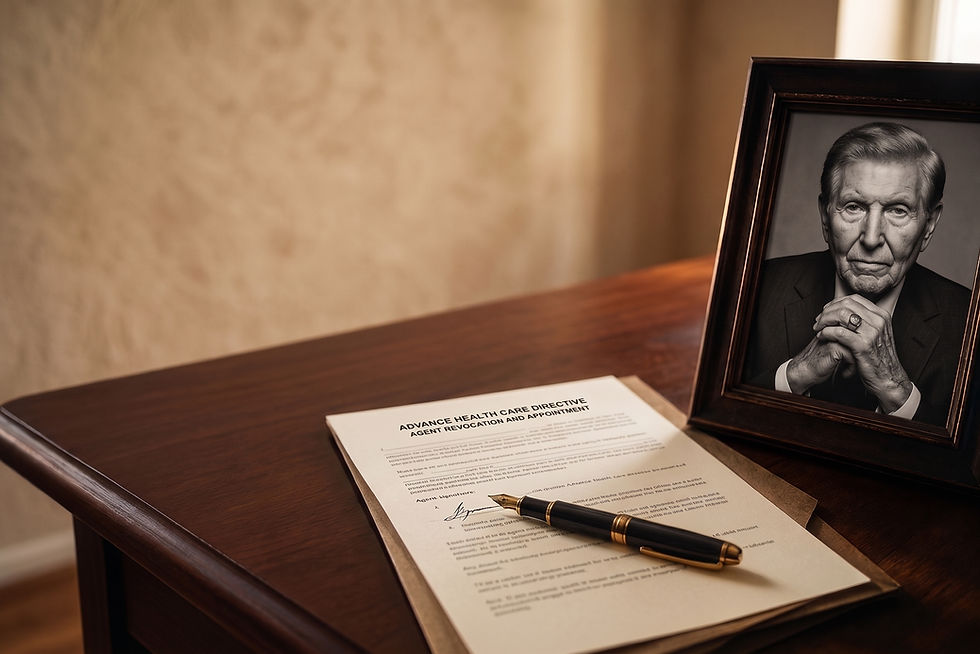
Thirteen days before Marlon Brando died in his house above Mulholland Drive in July 2004, he signed a codicil that shifted authority over his estate away from two advisers who had managed his affairs for years and toward three people who had known him only at the very end. Brando was gravely ill by then, tethered to oxygen and, by most accounts, rarely lucid enough to run his own household, let alone rewrite who would run it after he was gone. The document he signed on June 18, 2004 became the seed of a lawsuit filed two years later by the woman who had actually run that household, and it raises the question every estate plan is supposed to settle in advance: what happens to a promise a client made in life, once nothing in writing says so?
No court ever ruled on the merits of what followed, so the dispute produced no published opinion — but a sworn civil complaint, filed in a courthouse and built to withstand cross-examination, is still a different kind of document from a celebrity retrospective. The Associated Press's wire reporting on Angela Borlaza's July 2006 lawsuit against Brando's executors, and its follow-up on the case's December 2006 settlement, tracked the underlying Los Angeles Superior Court filings directly rather than the secondhand mythology that has circulated about Brando's estate ever since. That is the more reliable record to build on here.
Angela Borlaza joined Brando's household in 1995 as a cook and, over the following years, became his de facto major domo, managing his home, his medications, and much of his daily life. In 2002, Brando bought her a house in the San Fernando Valley, keeping the deed in his own name for tax purposes; Borlaza would later claim he had promised, in conversation, that the house would be hers outright when he died. No such bequest appeared anywhere in his estate plan. When Brando died on July 1, 2004, at eighty, his assets — the Mulholland Drive property, his beloved Tahitian atoll of Tetiaroa, art, scripts, and personal effects, valued altogether at roughly $21.6 million — passed into a trust that California law did not require to be made public.
The codicil signed thirteen days earlier had replaced Alice Marchak and Jo Ann Corrales, the advisers who had long managed Brando's affairs, with producer Mike Medavoy, business manager Larry Dressler, and family friend Avra Douglas as the estate's executors. Borlaza was evicted from the house in March 2005. In July 2006 she sued, alleging that the codicil had been signed while Brando lacked capacity, that his signature might have been forged, and that the executors had breached an oral promise to leave her the property outright. By December 2006, with the estate facing an additional $2 million punitive-damages claim, the parties settled through mediation for $125,000.
Brando's plan carried a second layer of complexity that had nothing to do with Borlaza: providing for a genuinely large and blended family. His will and the trust behind it named ten living children, ranging in age from ten to forty-six, born of different mothers across decades of relationships — among them Christian Brando, his son with first wife Anna Kashfi, and several children with Tarita Teriipaia, his Tahitian co-star and longtime partner. The documents went further than simply naming beneficiaries; they explicitly excluded his adopted daughter, Petra Brando- Corval, and the young son of his late daughter Cheyenne, along with their descendants — a deliberate disinheritance, not an oversight.
For estate planners, the Borlaza dispute illustrates a narrow but recurring vulnerability: an oral promise, however sincerely made and however many years of devoted service stand behind it, is generally unenforceable against a written estate plan. California, like New York, requires that gifts of real property and testamentary bequests carry the formality the law demands. Layered on top of that is the separate question the codicil itself invited: whether a document executed thirteen days before death, by someone reportedly confused and medicated, reflects genuine testamentary intent or the influence of whoever was standing closest when it was signed. The estate never had to answer that question in open court, and $125,000 bought certainty a trial might not have.
This is not a problem confined to movie stars with island retreats. Any family that has relied on a home health aide, a longtime housekeeper, or a caregiving relative in a parent's final years will recognize the shape of this story. Verbal assurances made in gratitude — this house will be yours, you'll be taken care of — get made constantly and honored in writing far less often, and the space between the two is where litigation lives.
The remedy is not complicated, only disciplined. Any promise a client intends to survive them should be reduced to writing while they are unquestionably competent — ideally well before a health crisis, with contemporaneous notes or a formally executed codicil signed under a lawyer's supervision rather than at a bedside. Blended families with children from multiple relationships should name each child individually rather than trust that generic language will be read the way the client intends, and any deliberate exclusion should be stated plainly enough that no one can later argue it was an oversight.
Estate Planning Lesson: A promise made at a bedside is not a bequest until it is written, witnessed, and signed.