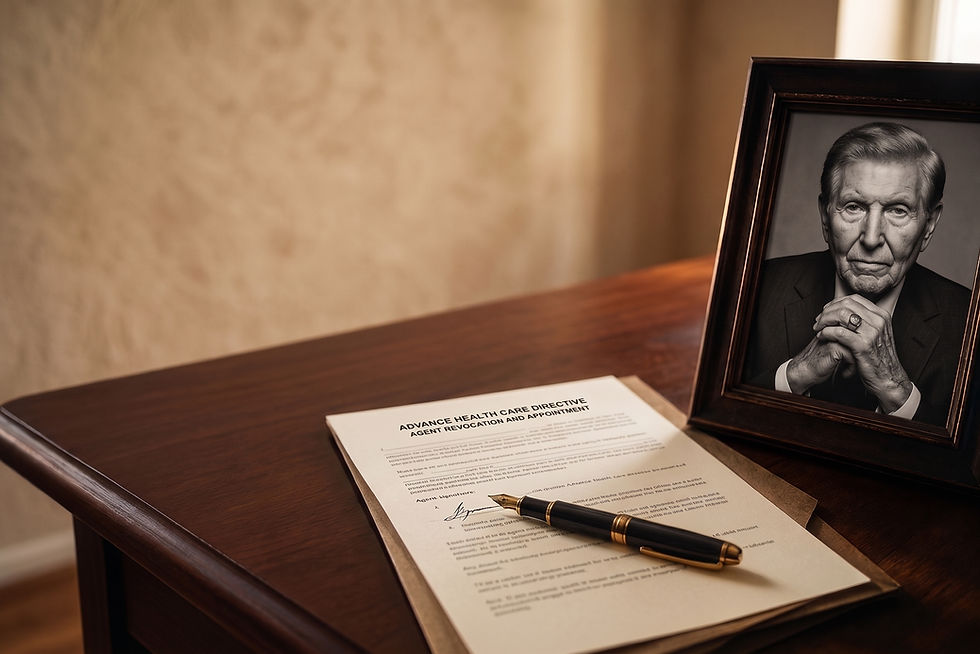
Howard Hughes's Estate and the Document That Filled the Silence
Howard Hughes died on April 5, 1976, aboard an aircraft carrying him from Acapulco toward a hospital in Houston. He was one of the wealthiest men in America and, by the end, one of the most withdrawn. What he did not leave behind was a will anyone could produce. The estate that followed is worth studying not for its size but for its shape: an enormous fortune, no instructions, and years of litigation over questions an afternoon at a lawyer's desk might have settled. The absence of a plan is itself a kind of plan, and a vacuum at the center of an estate does not stay empty for long.
The story is documented in the Deseret News archives, in Chris Miller's 2024 retrospective “Deseret News archives: Attention on Melvin Dummar, Howard Hughes will was overwhelming.” It gathers the paper's contemporaneous reporting on the handwritten document that surfaced after Hughes died, the Utah man named in it, and the trial that followed.
Weeks after Hughes's death, a handwritten document appeared at the Salt Lake City headquarters of The Church of Jesus Christ of Latter-day Saints. It divided his estate into sixteen equal shares, one to the church itself and one — in a line that would define the rest of a man's life — to “Melvin DuMar.” Dummar ran a gas station in Box Elder County, Utah. He said that in the late 1960s he had come upon a disheveled, injured man in the Nevada desert, driven him to Las Vegas, and given him a quarter for a phone call. The man, Dummar said, told him he was Howard Hughes.
Whether that encounter happened has been argued for nearly fifty years. What is documented is what happened to the paper. Dummar's fingerprint was found on the envelope. He had first said a stranger left the document at his gas station; he later acknowledged delivering it to church headquarters himself. Shifting accounts are corrosive in a courtroom whatever lies beneath them, and on June 8, 1978, a Nevada jury found the will was not authentic.
That verdict deserves precision: it was a civil finding in a probate contest about a piece of paper. Dummar was never convicted of forging anything, and no criminal case established who wrote it. He kept to his account for the rest of his life, was portrayed sympathetically in Jonathan Demme's 1980 film “Melvin and Howard,” and died in 2018 still maintaining the desert encounter was real. Other purported wills surfaced; none was accepted as authentic. Hughes was determined to have died intestate, and his fortune was eventually divided among cousins on his mother's and father's sides, after years of proceedings.
For estate planners, the most important point is not the mystery. It is that a fortune with no instructions is an invitation. When nothing authoritative exists, something else will eventually be offered, and the people left behind end up comparing handwriting instead of following directions. It is the same phenomenon the Marilyn Monroe post described, from the other side: a paper trail can be distorted, but an empty file can simply be filled. The safeguard is unglamorous — knowing where the signed original physically sits, and making sure someone trustworthy knows too. And intestacy is not a neutral result but a distribution scheme written by the legislature, applied without regard to what you would have chosen.
That problem is not reserved for billionaires. Missing originals are common: a will lost in a move, sealed in a safe deposit box no one can open, or left with a firm that has closed. New York treats the situation strictly: under SCPA 1407, a lost or destroyed will may be admitted to probate only if it is established that the will was not revoked, its execution is proved as for an existing will, and its provisions are clearly proved by two credible witnesses or a true and complete copy. New York courts also presume that a will last in the testator's possession and missing at death was destroyed with intent to revoke it. The presumption does not arise in every case — where the original was left in an attorney's custody, courts have declined to apply it — but the risk is real, and a good reason to decide deliberately who holds the signed original.
A well-built plan answers these questions in advance. It exists as a properly executed original, stored somewhere secure and known to the right people. It names fiduciaries willing and able to serve, and it is revisited when life changes. It uses trusts where privacy or protection matters, so that family details do not become a public filing by default. None of that is dramatic, and that is the point. The families who stay out of the courthouse are usually the ones whose planning was quiet, current, and findable.
Estate Planning Lesson: A missing will is not a blank page but an opening, and the surest protection is a properly executed original that the right people can actually find.