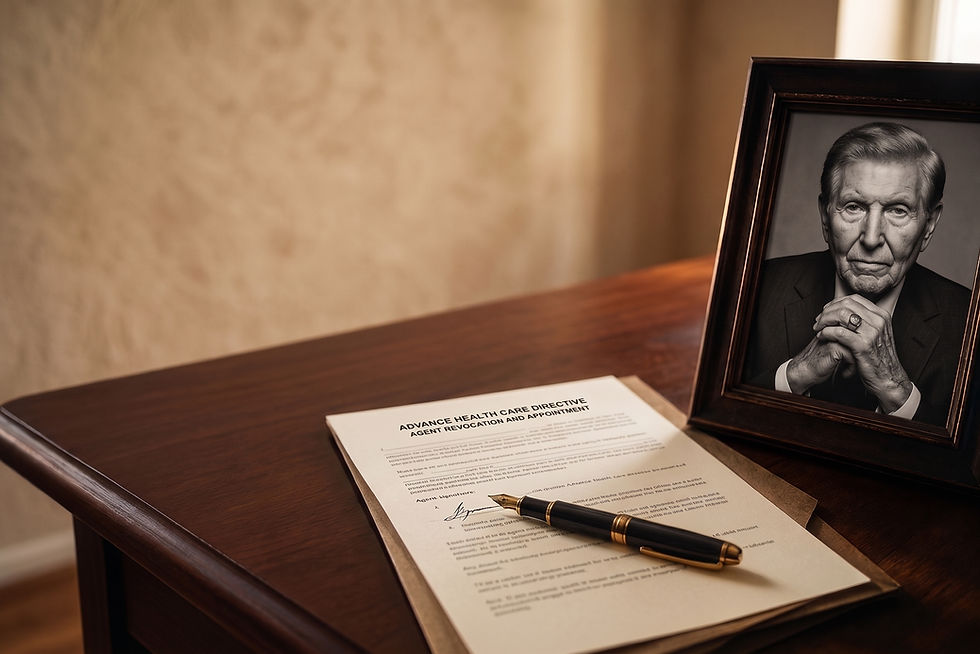
Aretha Franklin's Estate and the Spiral Notebook in the Couch
Aretha Franklin died on August 16, 2018, at her home in Detroit, at 76, of pancreatic neuroendocrine cancer. For months, her family and her lawyers proceeded on the understanding that the Queen of Soul had left no will. That held until the following spring, when a relative searching the house for records found handwritten pages in two places. What followed is instructive not because Franklin was famous, but because the pages she left were the kind ordinary people leave.
Reid Kress Weisbord, Distinguished Professor of Law and Judge Norma L. Shapiro Scholar at Rutgers Law School, and David Horton, Martin Luther King, Jr. Professor of Law at the University of California, Davis, School of Law, answered questions about the case for The Conversation in 2023 in a piece titled “Why a handwritten will found in Aretha Franklin's couch got R-E-S-P-E-C-T from a jury.” Co-authors of a leading wills and trusts casebook, they explain what the jury decided, why an unusual signature did not sink the document, and what such fights cost heirs.
In May 2019, a search of Franklin's suburban Detroit home turned up three handwritten documents: two dated 2010 in a locked cabinet, and one dated 2014 in a spiral notebook wedged into a couch's cushions. None had been prepared by a lawyer or witnessed. They addressed how her property, including her Detroit-area real estate and music income, should pass to her four sons. Michigan honors such a document: a handwritten will needs no attesting witnesses there if it is dated and the signature and material provisions are in the testator's own hand. No American jurisdiction, Weisbord and Horton note, requires a will to be typed or professionally drafted.
The 2014 pages were hard going: four sheets of cross-outs, marginal additions, and passages difficult to decipher. The document did not close with a conventional signature; a smiley face appeared immediately before the name Franklin. Any mark a person intends as a signature will serve, the professors note. The versions diverged on substance. The 2010 pages conditioned certain benefits on two sons completing business coursework; the 2014 pages dropped that and directed the Bloomfield Hills home to her youngest son, Kecalf. Three of the four sons took part, Kecalf and Edward backing the 2014 document and Ted White II the 2010 one; Clarence, who lives under a guardianship, did not. In July 2023, after a brief trial in Oakland County Probate Court in Pontiac, a jury deliberated less than an hour and found the 2014 document valid.
For estate planners, the most important point is not that the notebook won. It is that valid and clear are different things. The 2014 pages were legally effective, and arriving at that answer still took nearly five years and a jury trial, paid for out of what the sons would have received. Weisbord and Horton, who studied hundreds of San Francisco probate files, put the added fees in such disputes at roughly $17,000 on average; multi-year fights cost far more. The New York contrast is sharper. Michigan honors unwitnessed handwritten wills; New York, as a general matter, does not. Under EPTL 3-2.2, a will written entirely in the testator's hand but not executed with the statutory formalities is valid here only if made by an armed forces member in actual military or naval service during a war or other armed conflict, by someone serving with or accompanying such a force, or by a mariner at sea, and even then it lapses, generally a year after discharge or three years after execution for a mariner. A handwritten page can still be a valid New York will, but only if signed and witnessed like any other. A notebook in a couch would not be.
None of this turns on fame. The property at issue was a house, some vehicles, and streams of income, the inventory that occupies most families. People write things down on legal pads and in notebooks. They tell one child one thing and another something else. They mean to see a lawyer and never do. When they die, those fragments become the evidence, and the people left to read them have the most to lose by guessing wrong.
A well-built plan removes the guessing. It uses one instrument, properly executed under New York's formalities, that revokes whatever came before. It says plainly who receives the house, the business, and the accounts. It names a fiduciary who can act without being fought. It protects a beneficiary who needs protecting, often through a supplemental needs trust. And it lives somewhere findable, with counsel or on deposit with the Surrogate's Court, so no one has to search the furniture. Franklin's handwriting proved sufficient to establish what she wanted. It was not sufficient to spare her family the years spent proving it.
Estate Planning Lesson: A document can be legally valid and still cost a family years of litigation; what actually protects them is a plan that is clear, properly executed under New York law, and easy to find.